
Key Takeaways
- ARC welding machines are crucial for various industries, ensuring strong and durable metal joining solutions.
- Choosing the right ARC Welding Machine Manufacturer in India impacts productivity, weld quality, and long-term cost.
- These machines excel in high-demand applications like structural steel fabrication, shipbuilding, and pipeline construction.
- ARC welding eliminates the need for shielding gas, reducing costs and improving efficiency in field applications.
- Modern inverter-based ARC welders provide precise control, resulting in superior weld quality with minimal spatter.
Arc welding machines have become an essential part of modern manufacturing, fabrication, construction, and engineering industries. These machines play a crucial role in joining metal components with precision, strength, and durability. From small workshops to large-scale industrial facilities, arc welding technology continues to support production processes that require reliable and high-quality metal joining solutions.
As industries continue to expand and demand stronger metal structures, the importance of selecting the right welding equipment has increased significantly. Companies seeking dependable welding solutions often look for an experienced ARC Welding Machine Manufacturer in India capable of delivering quality equipment designed for various industrial applications. Parag Electrodes Agencies Pvt. Ltd. has been associated with providing welding solutions that meet the requirements of different industrial sectors.
How an ARC Welding Machine Works — The Process Explained
Before diving into applications and advantages, it helps to understand the working process clearly. The physics of ARC welding is straightforward, but the engineering that goes into making a reliable, controllable ARC welding machine is more involved than it appears from the outside.
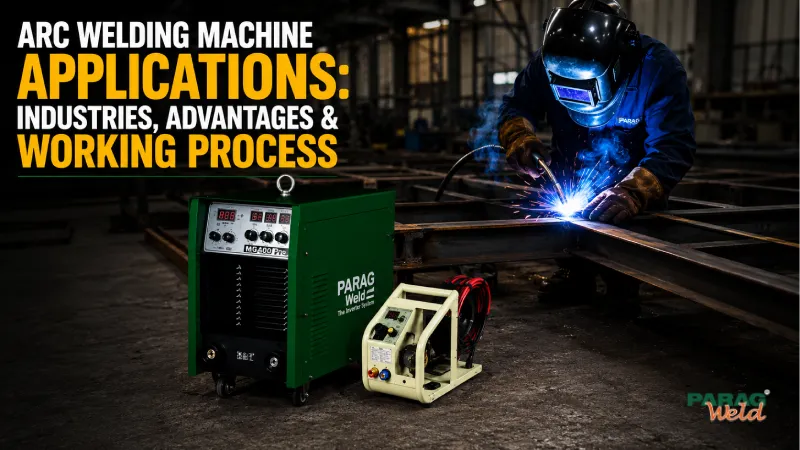
The Electric Arc: An ARC welding machine works by generating an electric arc between a consumable electrode (the welding rod or stick) and the base metal workpiece. The arc is struck by briefly touching the electrode to the workpiece and then withdrawing it to maintain a small gap — typically 2 to 4 mm depending on the electrode diameter and current setting. The arc temperature reaches approximately 6,000°C, easily sufficient to melt both the electrode and the surface of the base metal.
The Weld Pool: The intense heat of the arc creates a molten pool on the base metal surface. Simultaneously, the electrode melts and deposits filler metal into this pool. The flux coating on the electrode also melts, producing a shielding gas and a slag layer that protects the molten weld pool from atmospheric contamination — primarily from oxygen and nitrogen, which would cause porosity and brittleness in the solidified weld.
Solidification and Slag Removal: As the welder moves the electrode along the joint, the weld pool solidifies behind it into a fused weld bead. The slag layer on top of the bead is chipped off after cooling, revealing the completed weld underneath.
The Machine's Role: The ARC welding machine provides the controlled electrical power that drives this process. Modern inverter-based ARC welders — like those in Parag Electrodes Agencies' ARC Welder Series — regulate the output current with high precision, maintaining a stable arc even when the arc length varies slightly due to hand movement. This current stability is what separates a well-engineered machine from a basic one, and it directly affects weld quality, spatter levels, and ease of operation.
Key Industrial Applications of the ARC Welding Machine
The versatility of the ARC Welding Machine is one of its defining strengths. Unlike some welding processes that are limited to specific metals, joint configurations, or environments, ARC welding works across a remarkably broad range of applications.
Heavy Fabrication and Structural Steel
This is where ARC welding has always been strongest. Structural steel fabrication — beams, columns, trusses, frames, and support structures for buildings, bridges, industrial platforms, and heavy equipment — relies heavily on ARC welding for its ability to handle thick plate and structural sections in all positions: flat, horizontal, vertical, and overhead. The ARC welding machine's portability and independence from shielding gas cylinders make it particularly practical for site welding of structural steelwork, where MIG welding would be sensitive to wind interference.
Shipbuilding and Marine Fabrication
Shipyards are among the most demanding environments for welding, and ARC welding has been a core process in shipbuilding for generations. Hull plating, frame welding, bulkhead construction, and pipe welding in marine environments all use ARC welding extensively. The process handles the heavy plate thicknesses common in ship hulls, tolerates the outdoor and sometimes humid conditions of shipyard work, and can be performed in the restricted-space positions often encountered inside a ship's structure.
Pipeline Construction and Oil & Gas
Pipeline welding — particularly for oil and gas transmission lines — demands weld integrity that can withstand high internal pressures, external soil loading, and temperature cycling over decades of service. ARC welding, often using cellulosic electrodes for root passes and low-hydrogen electrodes for fill and cap passes, is the established process for field pipeline welding in India and globally. The ARC Welding Machine's ability to operate from portable generators in remote field locations, where gas supply and electricity grid access are unavailable, makes it the only practical choice for cross-country pipeline construction.
Forging and Casting Repair
Forging shops and foundries regularly need to repair defective castings, build up worn surfaces on forging dies, and weld repair cracked or damaged components. ARC welding with appropriate electrodes — including specialty hard-facing and stainless steel electrodes — handles these repair applications well. Parag Electrodes Agencies Pvt. Ltd. has served forging and casting customers since its founding in 1980, supplying both ARC welding machines and the specialist welding electrodes needed for these demanding repair applications.
Automotive and Transport Equipment Manufacturing
Chassis welding, frame fabrication, trailer construction, and the manufacturing of buses and trucks all involve substantial structural welding that ARC welding machines handle effectively. While MIG welding dominates in high-volume, thin-sheet automotive body welding, the heavier structural components of trucks, trailers, and off-road vehicles are routinely welded with ARC processes.
Maintenance and Breakdown Welding
Across every industry — from sugar mills and cement plants to textile factories and food processing facilities — maintenance welding is a constant requirement. Cracked machine frames, broken brackets, worn conveyor components, and damaged structural elements all need welding repair. The ARC welding machine's simplicity, robustness, and independence from bottled gas makes it the standard maintenance welding tool in most Indian factories. A maintenance technician can carry an inverter ARC welder to any part of the plant, plug it in, and be welding within minutes.
Construction — Reinforcement Bar Welding and Structural Work
Large construction projects — bridges, industrial buildings, power plants, and infrastructure projects — use ARC welding for structural steel connections, rebar welding in reinforced concrete structures, and the fabrication of embedded steel items. Site construction conditions — outdoor exposure, variable power supply, multiple access levels — are precisely the environment where the ARC welding machine's field practicality shines.
Advantages of Using an ARC Welding Machine
Why does the ARC Welding Machine remain so dominant across such a wide range of industries despite the availability of more technically advanced welding processes? The answer comes down to a set of practical advantages that are particularly relevant in Indian industrial conditions.
No Shielding Gas Required: Unlike MIG and TIG welding, which need bottled shielding gas, ARC welding relies on the flux coating of the electrode for arc and weld protection. This eliminates the cost, logistics, and supply chain dependency associated with gas cylinders. For field work, remote site work, and facilities in smaller towns where gas supply is unreliable, this advantage is decisive.
Works on a Wide Range of Metals: Carbon steel, stainless steel, cast iron, and a range of alloy steels can all be welded with the appropriate electrode selection. This versatility across metals and applications means that a single ARC welding machine can serve multiple needs in a workshop or on a site.
Superior Weld Quality with Precise Control: Modern inverter-based ARC welders from Parag Electrodes Agencies Pvt. Ltd. deliver precise control of welding variables — current output, arc force, and hot start characteristics. This control produces superior, precise quality welds with minimal spatter and excellent bead appearance. The quality achievable with a well-set inverter ARC welder on a clean joint is genuinely high — sufficient for structural, pressure vessel, and pipeline applications when welded by a qualified welder.
Welds with Little or No Filler for Thin Sections: On thin material and for specific joint configurations, ARC welding can be performed with minimal filler addition, using a technique that limits dilution and heat input. This flexibility in filler deposition is useful in repair welding, where preserving base metal properties while making a sound weld is important.
Portability and Field Practicality: Modern inverter ARC welders are compact and lightweight — a far cry from the heavy transformer-based machines of earlier decades. An inverter ARC welder from Parag Electrodes Agencies weighs a fraction of what older machines did, making it genuinely portable for site work and maintenance applications.
Cost-Effective for Variable Production: For workshops and fabricators with variable production — different job types, different material thicknesses, different joint configurations from week to week — the ARC welding machine's flexibility means it handles the full range without requiring process changes or different equipment setups.
Tolerates Imperfect Base Metal Conditions: ARC welding, particularly with certain electrode types, tolerates light rust, mill scale, and minor surface contamination better than MIG or TIG welding. This practical tolerance is important in maintenance welding, structural repair, and field construction where ideal surface conditions are not always achievable.
Selecting the Right ARC Welding Machine for Your Application
Not all ARC welding machines are the same, and choosing the right one for your application has a real impact on productivity, weld quality, and long-term equipment cost.
Current Output Range: Match the machine's output range to the electrode diameters and material thicknesses you will be welding. Light fabrication and maintenance welding can be handled by machines in the 160–200A range. Heavy structural and pipeline welding needs machines in the 400–630A range. Parag Electrodes Agencies' ARC Welder Series covers this full range, including the ARC-630i for heavy industrial applications.
Duty Cycle: The duty cycle specifies what percentage of a 10-minute period the machine can weld at its rated current without overheating. A 60% duty cycle at 400A means the machine can weld for 6 minutes and must rest for 4 minutes in each 10-minute period. For continuous production welding, specify a machine with a high duty cycle at the current you will actually use.
Power Supply Compatibility: Check whether the machine operates on single-phase or three-phase supply, and confirm the input voltage range is compatible with your site's supply. Modern inverter machines often have wide input voltage tolerances — an important feature in areas of India where supply voltage can vary.
Inverter vs Transformer: Modern inverter technology delivers better arc stability, lower energy consumption, and significantly lower weight compared to older transformer-based machines. For new purchases, inverter-based ARC welders are the correct choice for most applications.
Why Choose Us
Parag Electrodes Agencies Pvt. Ltd. has been building welding machines in Ahmedabad since 1980 — over 40 years of manufacturing experience, 5,000+ satisfied clients, and a product range of 50+ welding products that covers every major welding process used in Indian industry. As a leading ARC Welding Machine Manufacturer in India, the company designs its machines with the actual needs of Indian welders and fabricators in mind: robust construction for demanding shop and site environments, wide input voltage tolerance for India's variable power supply conditions, and precise arc control that makes quality welding accessible to operators across skill levels. Parag Electrodes Agencies Pvt. Ltd. does not just supply equipment — the company supplies welding solutions, backed by the deep application knowledge that comes from four decades of serving fabrication shops, machine shops, forging units, and casting facilities across India and internationally. When you choose a machine from Parag Electrodes Agencies, you are choosing a product built by people who genuinely understand what Indian welders need from their equipment every day.
Conclusion
The ARC Welding Machine has earned its place at the center of Indian industrial metalworking through decades of proven performance across the most demanding applications — from structural fabrication and pipeline construction to shipbuilding, forging repair, and everyday maintenance welding. Its combination of versatility, field practicality, and weld quality makes it the tool of choice for industries where reliability matters more than anything else. Parag Electrodes Agencies Pvt. Ltd. brings over 40 years of ARC welding machine manufacturing expertise to every product it builds, delivering machines that perform precisely, last reliably, and serve Indian industry the way it deserves to be served.
Connect with Parag Electrodes Agencies Pvt. Ltd. — India's trusted ARC Welding Machine Manufacturer in India — for expert guidance, product specifications, and quotes tailored to your welding application. Call us: +91 98240 99621 or email info@paragweld.com.