
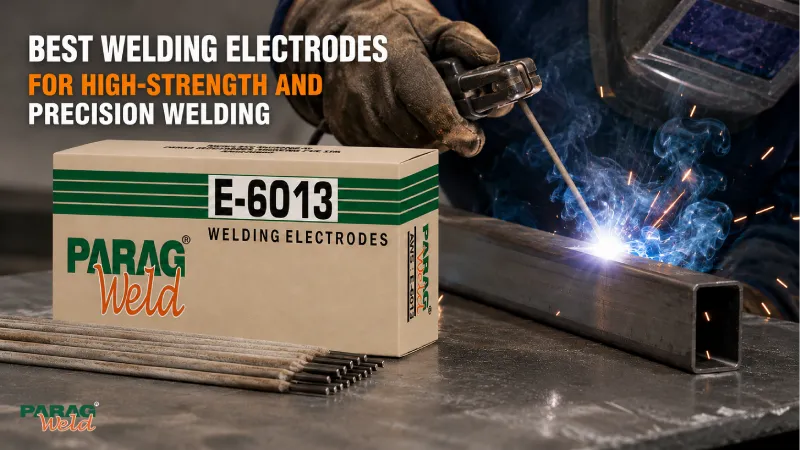
Key Takeaways
- Choosing the right welding electrodes significantly improves weld strength, durability, and project success.
- Quality welding electrodes reduce spatter, stabilize arcs, and minimize cleanup time, enhancing overall productivity.
- Welding Electrodes Manufacturers in Ahmedabad offer reliable solutions tailored for high-strength and precision welding needs.
- Investing in premium electrodes from trusted manufacturers prevents costly project delays and weld failures.
- Electrodes with low-hydrogen flux coatings are essential for preventing cracking in high-strength applications.
Welding is one of the most critical processes in modern manufacturing, construction, fabrication, automotive production, infrastructure development, and industrial maintenance. The quality of a welded joint depends heavily on the type of welding electrode used during the welding process. Choosing the best welding electrodes can significantly impact weld strength, durability, appearance, and overall project success.
When industries demand high-strength and precision welding, selecting the right electrode becomes a vital decision. High-quality welding electrodes contribute to strong fusion, minimal defects, improved efficiency, and long-lasting weld performance. Businesses across various sectors rely on trusted suppliers and Welding Electrodes Manufacturers in Ahmedabad to obtain products that meet stringent quality standards.
Parag Electrodes Agencies Pvt. Ltd. has established itself as a trusted name in the welding industry by offering premium-quality welding electrodes designed to meet diverse industrial requirements. Whether you are involved in heavy fabrication, structural steel projects, pipeline welding, machinery manufacturing, or repair work, understanding the role of welding electrodes can help achieve superior welding results.
So, What Exactly Is a Welding Electrode?
At its most basic, a welding electrode is a metal rod or wire that conducts electrical current to create an arc between itself and the base metal being welded. That arc produces the heat — intense, concentrated heat — that melts both the base metal and the electrode itself, fusing them together into a strong joint as the molten pool cools and solidifies.
Most welding electrodes used in industrial settings are coated with flux material. This coating does more than people often give it credit for. As the electrode burns, the flux melts too, forming a gas shield that keeps oxygen and nitrogen out of the molten weld pool. Atmospheric contamination is one of the leading causes of weld porosity — tiny gas pockets trapped in the solidified weld that dramatically reduce its strength. The flux coating prevents this.
Beyond shielding, the coating also stabilizes the arc, reduces spatter, and forms a slag layer over the finished bead that slows down cooling, reducing the risk of cracking. When the slag chips away cleanly, it leaves behind a smooth, properly formed weld bead. This is why easy slag removal is considered a sign of a well-made electrode — it is not a minor detail.
There are two broad types: consumable electrodes, which melt and become part of the weld itself (used in SMAW, MIG, and submerged arc welding), and non-consumable electrodes like tungsten, used in TIG welding where a separate filler rod is added. For the vast majority of structural and general fabrication work in India, consumable coated electrodes used in stick welding are the most common choice.
Why Cheap Electrodes Cost You More in the Long Run
This is a conversation worth having directly. Many buyers — especially smaller workshops and contractors — make purchasing decisions based almost entirely on price. And while cost is always a real concern, the economics of cheap electrodes rarely work out the way buyers expect.
A low-quality electrode typically causes one or more of the following: excessive spatter that sticks to the base metal and surrounding area, requiring grinding and cleanup; an unstable arc that makes the welder work harder and longer to produce an acceptable bead; slag that sticks and has to be chipped off aggressively, slowing down multi-pass work; porosity or incomplete fusion that requires the weld to be gouged out and redone; and in worst cases, weld failures that damage equipment, delay projects, or create safety hazards.
When you add up the labour time lost to cleanup and rework, the additional consumables used to fix poor welds, and the cost of potential project delays, the "cheap" electrode almost always ends up being the expensive choice.
This is precisely why industries that cannot afford weld failures — structural fabricators, pressure vessel manufacturers, oil and gas contractors — source their consumables from established Welding Electrodes Manufacturers in Ahmedabad with a proven track record. The small premium paid for quality electrodes pays back many times over in productivity, reliability, and peace of mind.
What Makes a Welding Electrode Suitable for High-Strength Work?
High-strength welding is not just about melting two pieces of metal together. It is about producing a weld joint that is mechanically equivalent to — or stronger than — the base material. In structural applications, that weld may be carrying loads for decades. In pressure vessels and pipelines, it may be holding back fluids under extreme pressure. The electrode used must be up to that responsibility.
Several technical factors define a high-strength welding electrode:
- Tensile Strength of the Deposited Weld Metal -is probably the most important specification. Standard mild steel electrodes typically deposit weld metal with tensile strength in the range of 480 to 530 MPa. For high-strength low-alloy steels used in structural construction, heavy equipment, and pressure vessels, higher-rated electrodes are needed.
- Low-Hydrogen Flux Coating — Hydrogen in the weld metal is the primary cause of a problem known as hydrogen-induced cracking or cold cracking. It occurs after the weld has cooled, sometimes hours or even days later, and can be catastrophic in thick sections or restrained joints. Low-hydrogen electrode coatings dramatically reduce the amount of diffusible hydrogen in the deposited weld metal.
- Impact Toughness at Low Temperatures— For applications in cold environments, or anywhere dynamic loading is involved, the weld metal must remain tough and resist brittle fracture even at temperatures well below ambient. This is measured through Charpy impact testing and is specified in the electrode classification.
- Consistent Chemistry — The mechanical properties of a weld depend on its chemical composition. Reputable manufacturers maintain tight control over the chemistry of both the core wire and the flux coating to deliver consistent properties from one electrode to the next. This consistency is something that separates genuine Welding Electrodes Manufacturers in Ahmedabad from lower-quality suppliers.
Precision Welding Demands Even More From the Electrode
While high-strength welding is about mechanical performance, precision welding is about control. It is used in automotive components, instrument housings, thin-section fabrication, decorative metalwork, and anywhere dimensional accuracy and surface quality are non-negotiable.In precision work, the welder needs to maintain exact arc length, deposit metal in a very controlled manner, and avoid excessive heat input that causes distortion or burn-through. An electrode that produces an erratic arc, too much spatter, or inconsistent penetration makes precision welding genuinely difficult — even for experienced operators.
The right electrode for precision welding strikes a delicate balance. It needs to produce a fine, stable arc that responds immediately to changes in arc length. It needs to deposit metal cleanly and smoothly, with a bead profile that requires minimal dressing. And it needs to do this consistently, rod after rod, without the welder having to compensate for variable performance.
Electrode diameter plays a major role here. For thin sections, a 2.50 mm electrode is the standard choice — it limits heat input and gives the welder precise control. Moving up to 3.15 mm adds deposition rate while still being manageable on medium-thickness material. For heavy fill passes and high-productivity structural work, 4.00 mm and 5.00 mm electrodes come into their own.
The Four Advantages That Set These Electrodes Apart
When Parag Electrodes Agencies Pvt. Ltd. describes the performance of their welding electrodes, four specific advantages are highlighted — and they are not marketing language. They are practical, measurable benefits that affect real workshop productivity:
- Low Spatter on Mild Steel Plates. Anyone who has spent time cleaning spatter off a freshly welded assembly knows what a time-sink it is. Spatter that welds itself onto the base metal or surrounding areas needs to be ground off, which adds labour time and risks damaging surface finishes. Low-spatter electrodes eliminate most of this work.
- Low Gas. Excessive fumes and gas generation is not just an environmental issue — it is a health and safety concern, particularly in enclosed workshops or confined-space welding. Electrodes that produce lower gas output reduce welder exposure to harmful fumes and contribute to a safer working environment.
- Smooth Welding. A smooth, stable arc reduces the physical effort required from the welder and produces more consistent bead geometry. This matters especially during long production runs where operator fatigue can otherwise lead to increasing inconsistency in weld quality.
Easy Flux Chipping. In multi-pass welding — where several weld passes are deposited one on top of another — inter-pass slag removal is a constant task. Slag that releases cleanly and completely speeds up the process significantly. Slag that sticks and requires aggressive chipping slows everything down and risks contaminating the next pass.
Industries That Depend on the Right Electrode
The reach of Welding Electrodes Manufacturers in Ahmedabad extends across virtually every sector of Indian industry. Parag Electrodes Agencies Pvt. Ltd. has built its client base across:
- Structural Fabrication — Steel structures, industrial sheds, bridges, and infrastructure projects where weld quality is audited and structural integrity is mandatory.
- Machine Shops and Engineering Works — Repair welding, component fabrication, and custom engineering work that demands clean, controllable weld deposits.
- Forging and Casting Industries — These sectors require specialized electrodes capable of welding the unique metallurgy of forged and cast metals without cracking or porosity.
- Heavy Equipment Manufacturing — Excavators, cranes, agricultural equipment, and material handling machinery are all fabricated and repaired using reliable welding consumables.
- Oil, Gas, and Petrochemical — Piping, pressure vessels, and storage tanks operating in demanding service conditions require electrodes with certified mechanical properties and full traceability.
- Automotive and Component Manufacturing — Consistent, reproducible electrode performance is essential for both small-batch component manufacturing and high-volume production processes.
Why Choose Us
Parag Electrodes Agencies Pvt. Ltd. has been part of the Indian welding industry since 1980 — long before most of today's welding equipment brands even existed. What started as a small operation in GIDC Vatva, Ahmedabad has grown into a company with 40+ years of hands-on experience, 5,000+ satisfied clients, and a product range that covers welding machines, electrodes, wires, and accessories. We are authorized stockists of Modi Arc Electrodes Company, one of India's most established electrode brands, and we bring that product quality together with genuine technical knowledge of what works in real workshops and production environments. Our welding electrodes are manufactured with consistent chemistry, reliable coatings, and performance characteristics — low spatter, smooth arc, easy slag removal — that professional welders notice immediately. When you buy from us, you are not just buying a consumable. You are buying four decades of application expertise and a team that actually cares whether your welds come out right.
Conclusion
At the end of the day, every strong, reliable weld starts with one simple decision — choosing the right electrode from the right manufacturer. Whether you are fabricating a structural steel frame, repairing a heavy casting, or working on precision components, the electrode you reach for will shape the outcome of that work. With over four decades of experience, a deep understanding of real-world welding requirements, and a product range built around consistent performance, Parag Electrodes Agencies Pvt. Ltd. remains one of the most dependable choices among Welding Electrodes Manufacturers in Ahmedabad. If quality welds matter to your business — and they should — then the consumables you choose matter just as much as the skills of the welder holding the rod.
Ready to upgrade your welding consumables and get the performance your work deserves? Reach out to Parag Electrodes Agencies Pvt. Ltd. — India's trusted welding partner — and let our experts guide you to the right electrode for every job. Call us: +91 98240 99621 or email info@paragweld.com.