
Key Takeaways
- Selecting the right welding wire is critical for achieving stronger and cleaner welds in diverse applications.
- This guide helps you choose the ideal welding wire for your specific project needs.
- Understanding wire chemistry directly impacts weld strength, appearance, and performance.
- Parag Electrodes Agencies Pvt. Ltd. is a trusted Welding Wire Manufacture and Supplier in India with decades of experience.
- Factors such as base metal compatibility, welding position, and working environment must guide your wire selection.
Welding quality depends on several factors, but one of the most important elements is selecting the right welding wire. Whether you are working on structural fabrication, automotive components, industrial machinery, construction projects, or general manufacturing applications, the welding wire you choose directly affects weld strength, appearance, productivity, and overall performance. Using the wrong wire can result in poor penetration, excessive spatter, weak joints, and unnecessary rework.
As industries continue to demand higher precision and reliability, understanding how to choose the right welding wire has become more important than ever. A suitable welding wire not only improves weld quality but also increases efficiency, reduces material wastage, and supports long-term durability. This guide will help you understand the essential factors involved in selecting the ideal welding wire for stronger and cleaner welds.
Parag Electrodes Agencies Pvt. Ltd. has been serving industries with high-quality welding solutions and helping customers choose products that match their specific welding requirements. As a trusted Welding Wire Manufacture and Supplier in India, the company focuses on delivering dependable welding products for diverse industrial applications.
Why the Welding Wire You Choose Changes Everything
Every welding wire has a specific chemical composition. That composition determines the chemical makeup of the deposited weld metal, which in turn determines its tensile strength, yield strength, elongation, and toughness. If you are welding high-strength structural steel and you use a wire with inadequate mechanical properties, the joint will be the weakest point in the structure — regardless of how good your technique is.
Beyond mechanical properties, the wire's chemistry also influences how it behaves during welding. Some wires produce a very fluid, low-viscosity weld pool that is easy to manipulate but requires careful heat management to avoid sagging. Others produce a stiffer pool that is more forgiving in out-of-position work. Wire chemistry affects spatter levels, porosity risk, bead profile, and how smoothly the arc transitions from wire to base metal.
Wire diameter matters too. Thinner wires — in the 0.8 to 1.0 mm range — are used for thin-section base metals, lower heat input applications, and precision welding. Larger diameters — 1.2 mm and above — are used for higher deposition rates on heavier sections. Using the wrong diameter for the job either leads to burn-through and distortion on thin material, or inadequate fusion and slow deposition on thick plate.
These are not minor variables. They are the fundamental parameters that separate a weld that passes inspection and performs in service from one that does not. This is exactly why sourcing from a reliable Welding Wire Manufacture and Supplier in India — one that controls wire chemistry tightly and maintains consistent dimensional tolerances — matters so much in practice.
The Two Main Wire Types in Industrial Welding
The welding wire market breaks down broadly into two main categories, each suited to different processes, applications, and working conditions. Understanding the difference between them is the starting point for making the right selection.
Solid MIG/MAG Wire
Solid wire is the most widely used wire type in semi-automatic and automatic welding worldwide. It is a plain wire — no flux filling, no coating — and it relies on an externally supplied shielding gas to protect the molten weld pool from atmospheric contamination.
In MIG welding (Metal Inert Gas), the shielding gas is typically pure argon or an argon-based mixture used for non-ferrous metals. In MAG welding (Metal Active Gas) — the far more common process in steel fabrication — the shielding gas contains CO₂ or a blend of argon and CO₂. The gas mixture affects arc characteristics, penetration profile, and spatter levels. Higher CO₂ content increases penetration and is more economical but produces more spatter. Argon-rich blends give a smoother arc, less spatter, and better bead appearance, at a higher gas cost.
The PW MAG-1 from Parag Electrodes Agencies Pvt. Ltd. is a solid copper-coated MAG welding wire designed for use with CO₂ or mixed gas shielding. It is suited for welding mild steel and low-alloy steel across general fabrication, structural work, automotive applications, and maintenance welding. Copper coating on the wire serves two purposes: it improves electrical contact at the contact tip, promoting arc stability, and it acts as a corrosion barrier to extend shelf life.
Solid wire's strengths are clean welds with minimal post-weld cleaning in clean, indoor environments, excellent bead appearance, and consistent mechanical properties. Its primary limitation is sensitivity to wind and draughts — anything that disturbs the shielding gas coverage will compromise weld quality. This makes it most suitable for workshop or factory environments rather than site work.
Flux-Cored Wire
Flux-cored wire is structurally different from solid wire. Instead of being a solid rod of metal, it is a tubular wire with a flux compound packed into the hollow core. During welding, this core flux melts and performs the same shielding and metallurgical functions as the flux coating on a stick electrode — protecting the weld pool, stabilizing the arc, adding alloying elements, and forming a slag layer over the bead.There are two sub-types: gas-shielded flux-cored wire, which still uses an external shielding gas alongside the core flux for added protection, and self-shielded flux-cored wire, which generates enough gas and slag from the core flux alone to operate without external shielding gas.
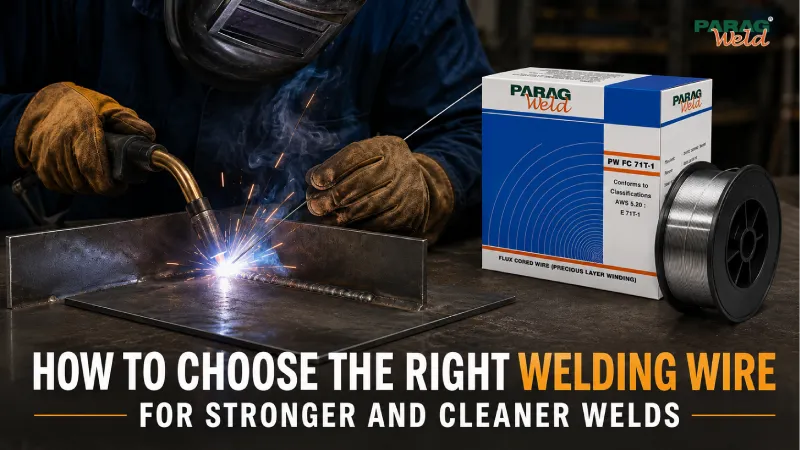
The PW FC 71T-1 from Parag Electrodes Agencies Pvt. Ltd. is a gas-shielded flux-cored wire classified to the AWS E71T-1 specification. This classification is widely recognized internationally as a standard for all-position mild steel flux-core welding. The "71" indicates a minimum tensile strength of 70,000 psi (approximately 480 MPa) in the deposited weld metal — adequate for structural carbon steel applications. The "T-1" designation denotes a rutile-type slag system with minimum spatter, smooth arc transfer, outstanding all-position welding performance, and simple slag removal.
Flux-cored wire's key advantages over solid wire are higher deposition rates, better performance on rusty or dirty base metals, and the ability to weld in draught conditions where shielding gas coverage would be disrupted. It is particularly valued in structural fabrication, shipbuilding, and any application where out-of-position welding or field work is required.
Understanding the AWS Classification System
When you look at a spool of welding wire, the alphanumeric classification printed on the label is not just a product code — it is a standardized description of the wire's performance characteristics, developed by the American Welding Society (AWS). Understanding this system means you can read the wire's capabilities directly from its label, without needing to rely on a manufacturer's marketing language.
For flux-cored wires like the PW FC 71T-1, the classification breaks down as follows: "E" stands for electrode. The first one or two numbers indicate the minimum tensile strength of the deposited weld metal in units of 10,000 psi. The next digit indicates welding position — "1" means all positions (flat, horizontal, vertical-up, overhead), while "2" means flat and horizontal only. The "T" identifies it as a tubular (flux-cored) wire. The final number describes the flux system type and recommended shielding gas.For solid MAG wires, the classification system is different but equally informative, covering the wire's chemical composition and the mechanical properties it delivers under specified testing conditions.
Buying from a Welding Wire Manufacture and Supplier in India that manufactures to AWS and IS standards — and labels their products clearly with verified classifications — gives you confidence that the wire you are using will actually deliver the mechanical properties and welding characteristics it is supposed to.
Five Practical Factors That Should Guide Your Wire Selection
Choosing the right wire is not an abstract exercise — it comes down to matching the wire's characteristics to the specific demands of your application. Here are five factors that experienced fabricators and welding engineers consistently prioritize:
- Base Metal Compatibility is the non-negotiable starting point. The deposited weld metal chemistry must be compatible with and ideally closely matched to the base material. For mild and low-alloy steels — the most common materials in general fabrication — standard carbon steel wires like the PW MAG-1 and PW FC 71T-1 are appropriate. For higher-strength steels, stainless steels, or other alloys, wire selection becomes more specific and must be guided by the base material specification.
- Required Mechanical Properties should be matched to the structural demands of the joint. A wire that deposits weld metal with lower tensile or yield strength than the base material creates an undermatched joint — a structural weak point. Most structural applications call for matched or slightly overmatched weld metal.
- Welding Position determines whether a solid wire or all-position flux-cored wire is more appropriate. For flat and horizontal welding in a controlled environment, solid wire delivers excellent results. For vertical-up, overhead, or any out-of-position work — particularly on site — an all-position flux-cored wire like the PW FC 71T-1 is the better tool.
Working Environment is critical when choosing between gas-shielded and self-shielded options. Workshop environments with controlled air movement are well-suited to gas-shielded processes. Outdoor or draught-prone environments favor flux-cored wire, particularly self-shielded types that do not depend on maintaining gas coverage.- Surface Condition of the Base Metal affects wire choice more than many welders realizes. Solid wire performs best on clean, properly prepared surfaces. Flux-cored wire is more tolerant of mill scale, light rust, and surface impurities — the flux system handles some degree of contamination without seriously compromising weld quality.
Common Wire Selection Mistakes and How to Avoid Them
Using the wrong diameter for the material thickness is probably the most frequent mistake. Running a 1.2 mm wire at high current on 2 mm sheet will cause burn-through and distortion. Running a 0.8 mm wire on 20 mm plate means multiple passes where fewer would do and very slow deposition. Match the diameter to the base metal thickness and the joint design.
Ignoring wire storage requirements is another common oversight. Welding wires — particularly flux-cored types — are vulnerable to moisture uptake. Moisture in the wire leads to hydrogen in the weld metal, which causes porosity and, in thicker sections, the risk of hydrogen cracking. Store wire in its original sealed packaging in a dry environment. Opened spools left on machines overnight in humid conditions accumulate moisture far faster than most operators appreciate.
Mixing wire brands or classifications mid-job can introduce inconsistency into a weld procedure, particularly on quality-critical or coded work where the procedure is qualified to specific consumables. Stick with the same wire specification throughout a job, sourced from a consistent Welding Wire Manufacture and Supplier in India whose product meets its stated classification reliably.
Why Choose Us
Parag Electrodes Agencies Pvt. Ltd. has been supplying welding consumables and equipment to Indian industry since 1980, building over four decades of application knowledge and a client base of more than 5,000 satisfied customers across the country. Our welding wire range — including the PW FC 71T-1 flux-cored wire and PW MAG-1 solid MAG wire — is manufactured to meet recognized AWS classifications, delivering the mechanical properties and welding performance that fabricators, engineers, and production teams depend on. As a committed Welding Wire Manufacture and Supplier in India, we do not just supply consumables — we help customers select the right wire for their specific base material, joint design, position, and service requirements, drawing on decades of real-world welding application experience. From our base in GIDC Vatva, Ahmedabad, we supply across India and bring the kind of technical depth and after-sales reliability that only comes from a manufacturer with genuine roots in the industry. When you source your welding wire from Parag Electrodes Agencies Pvt. Ltd., you are getting a consumable that is built to perform — and a supplier that stands behind every spool.
Conclusion
The welding wire you choose is one of the most consequential decisions in any welding operation — it shapes the strength, cleanliness, and reliability of every joint your team produces. Whether you need a high-deposition flux-cored wire for structural fabrication or a clean, consistent solid MAG wire for precision workshop work, getting the specification right from the start saves time, reduces rework, and delivers welds that perform in service. With over four decades of experience as a trusted Welding Wire Manufacture and Supplier in India, Parag Electrodes Agencies Pvt. Ltd. has the product range and the application knowledge to help you make that decision with confidence.
Looking for the right welding wire to get stronger, cleaner welds on your next project? Speak to our experts at Parag Electrodes Agencies Pvt. Ltd. we will help you find the perfect match for your application. Call us: +91 98240 99621 or email info@paragweld.com.