
Key Takeaways
- A Portable CNC Plasma Machine in India offers precision and repeatability for complex cutting tasks.
- Conventional plasma cutters provide manual flexibility for occasional or simple applications.
- CNC plasma machines improve workflow through programmed cutting paths and automation.
- Choosing the right cutter depends on the specific production needs and operator skill level.
- Consider factors like portability, material thickness, and required control features before deciding.
Parag Electrodes Agencies Pvt. Ltd. is a leading provider of CNC plasma cutting and welding equipment. When manufacturers compare a portable CNC plasma system with a conventional plasma cutter, the main question is not simply which machine cuts metal. The real consideration is how much control, consistency, flexibility, and automation the application requires. A Portable CNC Plasma Machine in India can be a practical choice for businesses looking for controlled and repeatable cutting operations.
What Is a Portable CNC Plasma Machine?
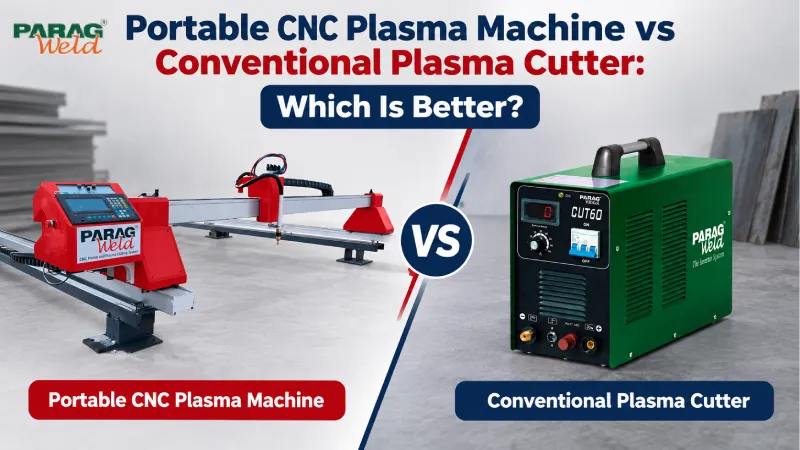
A portable CNC plasma machine combines plasma cutting with computer numerical control. Instead of manually guiding the torch throughout the cutting operation, a programmed system controls the torch movement along the required cutting path.
Our portable gantry-type system uses an aluminium structure with guide rails, linear guideways, rack-and-pinion movement, a plasma controller, torch height control, stepper motors, and double-drive operation. The system also supports nesting software for 2D cutting applications.
The biggest difference is automated torch movement rather than manual torch handling. This can make the cutting process more suitable for applications where repeatability and controlled movement matter. Learn more about the machine's capabilities on the product page.
What Is a Conventional Plasma Cutter?
A conventional plasma cutter generally relies on the operator to control the torch manually. The operator determines the cutting direction, follows the required line, and manages the cutting process directly.
This approach can be useful for repair work, maintenance, small fabrication jobs, and applications where shapes are relatively simple. However, the final result can depend heavily on operator control and cutting technique.
For straightforward work, a conventional cutter may be sufficient. For repeated shapes or programmed cutting requirements, CNC-based equipment offers a different level of control.
Portable CNC Plasma Machine vs Conventional Plasma Cutter
The two systems can both perform plasma cutting, but their operating methods are different. The following comparison can help B2B buyers evaluate which option fits their production requirements.
| Criteria | Portable CNC Plasma Machine | Conventional Plasma Cutter |
|---|---|---|
| Torch movement | CNC-controlled | Manually controlled |
| Cutting pattern | Programmed cutting paths | Operator-guided |
| Repeatability | Suitable for repeated programmed shapes | Depends more on operator consistency |
| Complex profiles | Better suited to programmed profiles | More dependent on manual skill |
| Production workflow | More automation-oriented | More manual |
| Operator involvement | Programming and machine operation | Continuous torch handling |
Where Does a Portable CNC System Have an Advantage?
A portable CNC configuration becomes particularly useful when the same type of cutting needs to be performed repeatedly. Once a cutting pattern is prepared, the CNC system can guide the torch according to the programmed path.
This is helpful for fabrication operations working with recurring components, profiles, or plate-cutting requirements. The machine listed by Paragweld also incorporates automatic torch height control with anti-collision and arc-voltage functions.
Another important advantage is flexibility. The Paragweld system is described as a portable gantry-type CNC flame and plasma cutting system, allowing businesses to consider a CNC format without automatically moving to a large fixed table configuration.
When Can a Conventional Plasma Cutter Be the Better Option?
A conventional cutter can make sense when the work does not require programmed movement. For occasional cutting, on-site adjustments, repair work, or simple shapes, manual control may be adequate.
It can also be suitable where the operator needs to make quick cutting decisions directly at the workpiece. In such situations, the simplicity of manual operation can be useful.
However, businesses should consider the nature of their work rather than choosing based only on machine type. The right cutter depends on whether your priority is manual flexibility or repeatable CNC-controlled movement.
What Should B2B Buyers Check Before Choosing?
Before selecting between the two systems, buyers should review their actual cutting workflow. A simple checklist can help:
- Check whether cutting profiles need to be repeated regularly.
- Review how much operator control is required during each cut.
- Consider whether CNC programming would improve the workflow.
- Check the required material thickness and suitable plasma power.
- Review torch height control and other machine-control features.
- Consider whether portability is useful for your fabrication setup.
For example, the specifications published for Paragweld's portable gantry system include the FLMC-2100B plasma controller, Leadshine stepper motor and drive, imported torch lifter, and aluminium guide rail.
Is CNC Better for Complex and Repeat Cutting?
For programmed cutting operations, CNC has a clear functional advantage because the machine follows digital cutting paths instead of relying entirely on continuous manual torch movement.
The system can also work with nesting software such as Most 2D, FLCHAM, and FastCHEM, according to the product information published by Paragweld.
This makes a Portable CNC Plasma Machine in India particularly relevant for fabrication businesses that need repeatable profiles and a more structured cutting workflow.
Which One Should Your Business Choose?
There is no single answer for every workshop. A conventional plasma cutter can remain useful for straightforward and occasional cutting where manual operation is practical.
A portable CNC plasma system is more appropriate when the business requires programmed cutting, repeatability, controlled torch movement, and greater integration into a fabrication workflow.
The decision should therefore be based on the type of components being produced, frequency of cutting, level of automation required, and machine configuration.
Why Choose Us
Parag Electrodes Agencies Pvt. Ltd. provides CNC plasma cutting solutions with a focus on industrial welding and cutting requirements. Our portable gantry-type CNC flame and plasma cutting system features CNC control, automatic torch height control, stepper motor drive, double-drive operation, guide rails, and supported nesting software. We work with B2B buyers to understand their cutting requirements and help them identify a suitable machine configuration for their applications.
Conclusion
Choosing between a portable CNC plasma machine and a conventional plasma cutter depends on how your business handles metal-cutting work. Conventional plasma cutters can be useful for manual and straightforward applications, while CNC systems are designed around programmed torch movement and repeatable cutting operations. For businesses seeking greater control over recurring cutting patterns and a more organised fabrication process, a Portable CNC Plasma Machine in India can be a practical solution. Reviewing your material, cutting profiles, workflow, and automation requirements will help you make the right purchasing decision.
Ready to upgrade your metal-cutting process with CNC control? Contact Parag Electrodes Agencies Pvt. Ltd. to discuss your application and machine requirements.
Call: +91 9824099621
Email: info@paragweld.com