Part One: Questions About the Work You Do
Answer these honestly before you look at a single model number. Most wrong purchases happen because a machine was chosen for the one difficult job a shop does twice a year, or for the cheapest price on the day, rather than for the work that fills everyday shifts.
1. Which metals and thicknesses make up most of your jobs?
General fabrication units in Peenya mostly handle mild steel from thin sheet up to thick plate, and for that a MIG/MAG machine gives the best balance of speed and finish. Shops feeding the aerospace and defence supplier base around HAL see far more stainless steel, aluminium and thin-wall sections for fixtures, ground-support equipment and enclosures. That work belongs to TIG, and aluminium in particular needs an AC/DC source such as the Paragweld pulse TIG AC/DC series, where pulse control keeps heat input low on thin parts.
2. How strict are your customers about repeatability?
Precision fabricators in Bengaluru often weld to written procedures, and an inspector may ask what current and voltage were used on a batch. Choose an inverter machine with a clear digital display and stable output so that a qualified welder can repeat the same settings on every shift. A machine that drifts as it warms up will cost you rework on close-tolerance parts.
3. Will the machine stay in the bay or travel to site?
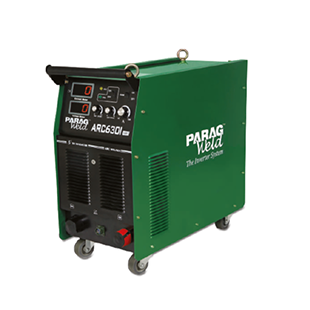
Machine-tool builders mostly weld inside a fixed bay, where weight does not matter. Maintenance and erection contractors working at automobile plants around Bidadi need something they can carry, run from a long cable and set up quickly. For site work, a compact ARC (MMA) inverter is usually the practical answer, even if the shop itself runs MIG.
4. How many hours does the arc actually run per shift?
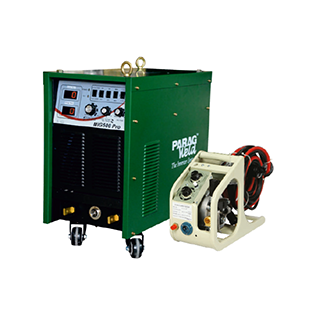
Component suppliers serving the Bidadi automobile plants frequently run MIG fixtures across two or three shifts. That calls for a machine with a high duty cycle at your working current, such as the Paragweld MIG 500 Pro, rather than a light-duty unit that has to stop and cool down in the middle of a batch.
Part Two: Questions About the Machine and Your Shop
5. Does your power supply match the machine?
Check whether your shed has a three-phase connection, how far the welding bay is from the panel, and whether the voltage dips when compressors or large machine tools start. Heavy-duty industrial welders are built for three-phase supply; single-phase machines suit light work and small units. If you run on a generator during power cuts, mention it so the machine and generator can be matched.
6. Do you need to cut as well as weld?
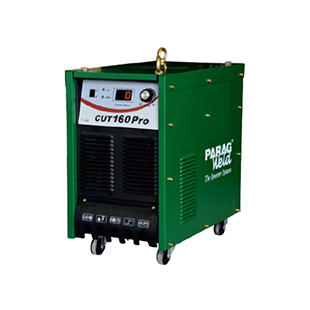
Many smaller fabricators still send profiles out for cutting. An air plasma cutter from the LGK or CUT series lets you cut brackets and gussets in-house, and shops cutting large volumes of plate can look at a CNC plasma cutting machine to hold consistent profiles.
7. Is it time to automate any seams?
If you weld the same long seam or circular joint every day, a welding carriage, rotator or submerged arc setup can improve consistency more than a better manual welder can. Buy the manual machine first, but ask whether it can later work with automation.
Part Three: Questions to Ask the Supplier
8. Who answers when the machine trips mid-shift?
Ask how troubleshooting works, how spares are arranged and who you should call. Paragweld supports Bengaluru buyers directly by phone and WhatsApp, with the team that knows how the machines are built.
9. Can the same source supply consumables?
Buying electrodes and wire from the maker of the machine makes it easier to get the recommended settings right from the first day.
10. What else does the machine need?
High-current TIG work needs a water-cooled torch and a water cooling unit. Budget for torches, cables and earth clamps so the machine is not held back by weak accessories.
Machine Families Bengaluru Buyers Shortlist Most
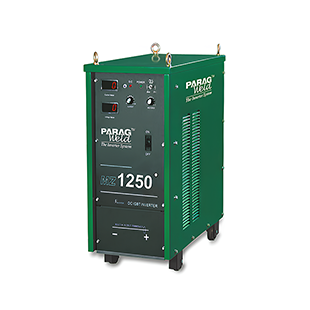
Once you have your answers, these Paragweld product families are where most of them lead:
Three Checklist Answers, Three Different Machines
- A Peenya job shop welding mild steel frames and guards: a MIG machine for daily production, plus a portable ARC inverter for repairs and site visits.
- A supplier making stainless and aluminium fixtures for aerospace customers: a pulse TIG AC/DC machine with water cooling, used by a welder who works to a written procedure.
- A tier supplier running two shifts of MIG fixtures near Bidadi: high duty-cycle MIG machines, a steady supply of matched wire, and a plasma cutter for trimming and rework.
Take the Checklist to the Paragweld Team
Note down your answers, even roughly, and share them with us. We deliver across Bengaluru and Karnataka from our Ahmedabad works, and our team can go through the checklist with you and suggest a machine that suits your work. You can also browse the full product range first.
Ready to discuss your Bengaluru workshop? Call us at +91 9824099621 or email paragltd@yahoo.co.in and tell us what you weld.