Why Weld Defects Cost Hyderabad Fabricators So Much
Much of Hyderabad's fabrication work goes to two demanding kinds of customer. Pharma and bulk-drug plants buy stainless-steel reactors, storage tanks, process piping and skids, and they need welds that are smooth, free of crevices and easy to clean. Defence and aerospace suppliers around Balanagar build fixtures, enclosures, ground-support equipment and precision assemblies that go through strict inspection. For both, a weld that looks fine to the eye can still be rejected. Preventing a defect costs far less than grinding it out, re-welding and inspecting it again.
Common Welding Problems and How to Fix Them
Problem 1: Heat tint and "sugaring" on stainless-steel pharma equipment
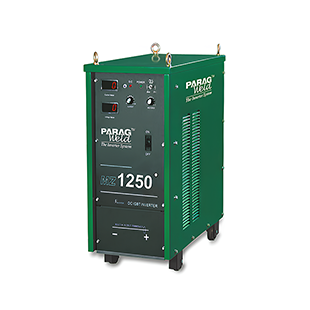
What you see: dark blue or grey oxide on the weld and heat-affected zone, or a rough, grainy root inside the pipe. Why it happens: too much heat input and poor shielding gas coverage, particularly on the inside of tubes and vessels. The fix: weld with DC TIG and fine current control, purge the root side with argon, keep interpass temperature low and use filler wire that matches the base metal (for example 316L on 316L). A steady inverter TIG such as the Paragweld TIG 400 IGBT suits shop work on vessels and pipe spools.
Problem 2: Distortion on thin sheet and panels
What you see: panels that bow, flanges that pull out of line and enclosures that no longer square up. Why it happens: long continuous runs put too much heat into thin material. The fix: tack in a balanced pattern, use stitch or skip welding, clamp the job to a fixture and use copper backing bars to draw heat away. Pulse TIG gives you a lot more control over heat input. The Paragweld pulse TIG AC/DC series also covers aluminium, which is often used for electronics housings in defence work.
Problem 3: Porosity in MIG welds
What you see: pinholes on the surface, or gas pockets that only show up on radiography. Why it happens: breeze through open sheds blowing the gas shield away, oily or painted plate, damp or rusty wire and incorrect gas flow. The fix: put up screens around the welding bay, degrease the joint, keep wire spools sealed and dry during the monsoon, check the gas hoses for leaks and set the flow to suit the nozzle size. A wire feeder that feeds smoothly also helps keep the arc stable.
Problem 4: Excess spatter on structural and machine-base work
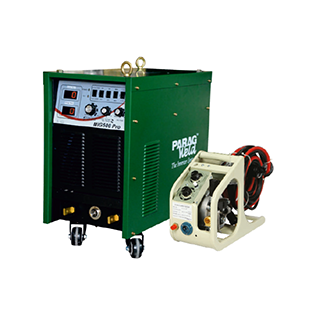
What you see: spatter stuck to the job and the nozzle, so every weld needs grinding afterwards. Why it happens: voltage and wire speed are out of balance, contact tips are worn or the gas is wrong for the finish you need. The fix: adjust voltage and wire speed together, change tips regularly, use an argon-CO2 mix where appearance matters and apply anti-spatter to nozzles. A stable inverter MIG such as the Paragweld MIG 500 Pro makes it easier to hold a clean arc through a shift.
Problem 5: Cracking on thick or alloy-steel sections
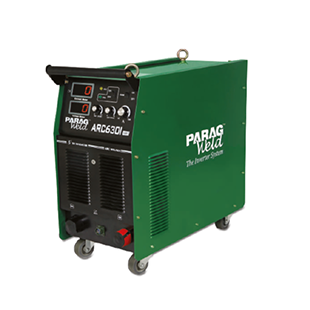
What you see: cracks along the toe or through the weld, sometimes appearing hours after welding. Why it happens: hydrogen from damp electrodes, high restraint and no preheat on thick plate. The fix: use low-hydrogen electrodes stored in a drying oven, preheat thick or hardenable steel, weld in a sensible sequence and let the job cool slowly. You need an MMA machine that runs large-diameter electrodes smoothly, such as the Paragweld ARC 630i.
Problem 6: Machines tripping in the summer heat
What you see: the thermal cut-out trips in the middle of a job, usually on hot afternoons. Why it happens: the machine is running close to its duty-cycle limit, dust is blocking its airflow and the torches overheat on long TIG runs. The fix: buy a machine with spare current capacity, keep it where air can circulate, blow out the dust regularly and add a water cooling unit for high-current TIG torches.
Paragweld Machines Behind These Fixes
These are the product families Hyderabad fabricators ask us about most often when they are trying to solve the problems above:
Before You Buy: Diagnose the Real Cause
A new machine will not cure a defect caused by damp consumables or a draughty bay, so check the basics first. When you contact us, it helps to have:
- a clear photo of the defect and the joint it appears on,
- the material grade and thickness,
- the process and machine you are using now,
- the power supply at your shop (single-phase or 3-phase 415V),
- the inspection or finish standard your customer asks for.
With that information our team can tell you whether the answer is a change of technique, a different consumable such as our welding wire or electrodes, or a machine that is better suited to the job.
How Paragweld Supports Buyers in Hyderabad
Paragweld ships machines to Hyderabad from its manufacturing unit in Ahmedabad. We help buyers there by phone, WhatsApp and through our sales team with machine selection, first-time setup and parameter settings for their material. Because we make welding electrodes and wire as well as the machines, you can buy the power source and the consumables for a pharma or defence job from one source. You can see the full range on our products page.
Tell us which welding defect is holding up your work in Hyderabad. Call us at +91 9824099621 or email paragltd@yahoo.co.in and we will suggest the right machine and consumables.